What the Bush Teaches You When Nobody's Talking
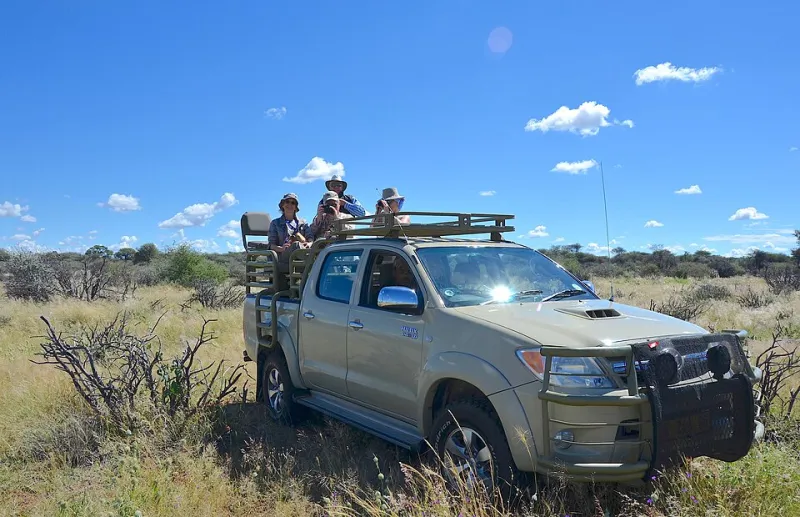
Photo: Olga Ernst & Hp.Baumeler, CC BY-SA 4.0, via Wikimedia Commons
You've probably spent most of your life filling silence. A quiet car ride gets a podcast. A lull in conversation gets a phone check. Stillness, in the American day-to-day, tends to feel like something that needs fixing.
Then you get to the Serengeti, and a lioness walks within thirty feet of your vehicle, and your guide says absolutely nothing.
And somehow — that moment becomes the one you'll describe for the rest of your life.
The Noise We Bring With Us
Most first-time safari travelers expect something close to a nature documentary. A knowledgeable voice narrating every movement, explaining every behavior, filling in the blanks. And look, there's real value in a guide who can tell you why a giraffe is spreading its legs to drink, or what that alarm call from the impala actually means.
But here's what a lot of tours don't account for: the human brain can only process so much at once. When your ears are busy decoding language, they're doing less of something else — picking up the world around you.
Researchers call this auditory selective attention. Your brain is constantly filtering sensory input, and when verbal information takes priority, ambient sound gets deprioritized. In practical terms, that means a guide explaining lion behavior while a lion is right in front of you might actually be pulling your brain away from the lion.
Silence, counterintuitively, gives your senses room to expand.
What Happens in Your Brain When the Talking Stops
Neuroscientists have studied what happens when people enter environments with reduced verbal input, and the findings are striking. The brain's default mode network — the system that handles self-referential thought, daydreaming, and mental wandering — tends to quiet down. In its place, the sensory cortex becomes more active. You start noticing things you'd normally filter out.
In the bush, that shift is almost immediate. The tick of cooling metal on the Land Cruiser. The specific dry-grass smell of the savanna at midday. The way a herd of zebra moves not quite in unison, each animal making micro-adjustments that ripple through the group. None of that registers when you're processing a five-minute explanation of zebra migration patterns.
Some guides — particularly those who've been leading trips for decades — have figured this out intuitively. They'll go completely quiet at critical moments, sometimes for ten or fifteen minutes at a stretch. No narration. No whispered commentary. Just the vehicle, the animals, and whatever your own senses can pick up.
Travelers who've experienced this style of guiding consistently describe those moments as the most memorable of their entire trip.
Real Stories From the Field
Kayla, a high school teacher from Portland, Oregon, had been on two previous safaris before her third trip to Botswana's Okavango Delta. She described her earlier experiences as "incredible but kind of exhausting — like being in a really good lecture that never stops."
On her Botswana trip, her guide made a habit of going silent whenever they encountered predators. "At first I kept waiting for him to say something," she said. "But then I started hearing things I'd never noticed before — the way the grass moved differently when something was in it, the sound a hippo makes when it's just barely submerged. I felt like I was actually in Africa instead of watching it."
Marco, a software engineer from Austin, described a similar shift during a walking safari in Zimbabwe. "Our guide stopped us and just stood there for probably eight minutes. I started counting bird calls because I didn't know what else to do. By the time we moved on, I'd heard at least six different species I never would have noticed if someone had been talking."
Both travelers noted something else: the memories from those quiet stretches felt sharper and more detailed than anything else from their trips. Which, it turns out, is exactly what the science would predict.
Why Silence Builds Stronger Memories
Memory consolidation is closely tied to emotional engagement and sensory specificity. The more sensory channels involved in an experience — sound, smell, sight, physical sensation — the more neural pathways get activated, and the more durable the memory becomes.
When you're in a conversation, your brain is essentially multitasking. It's encoding the words being spoken and trying to process the environment. Something usually gives.
But when the talking stops and you're left with just the raw experience, your brain goes all-in on the sensory data. That's why so many travelers can recall the exact quality of afternoon light during a silent game drive, or the precise moment a cheetah turned to look directly at them, in vivid detail years later — while the narrated parts of the same trip blur together.
Silence, in other words, isn't an absence. It's a delivery mechanism for memory.
How to Actually Use This on Your Safari
Knowing this is useful. You can actively shape how you experience a safari based on it.
Talk to your guide beforehand. Let them know you're interested in quiet observation periods, not just narrated encounters. Good guides will respect this — many will be relieved to hear it. Ask them to save explanations for before or after encounters rather than during.
Resist the reflex to fill silence. Americans especially tend to narrate their own experiences in real time — "Oh wow, look at that, it's turning, oh my gosh" — which is natural but genuinely interrupts your own sensory processing. Try staying quiet even when it feels uncomfortable.
Leave the earbuds out. This sounds obvious, but the temptation to have a podcast or playlist during transfer drives is real. Those quiet stretches between sightings are actually when your brain recalibrates and prepares to absorb the next encounter. Protect that time.
Notice what you smell and hear before you look. It sounds like a mindfulness exercise because it is one. Training yourself to register ambient sound and scent first gives your brain a richer sensory context before the visual information arrives.
The Loudest Thing About Africa Is What You Don't Say
There's a version of safari that's essentially a very expensive zoo tour — a guide pointing at things and explaining them while you photograph and nod. That version has its place, especially for first-timers who genuinely need context.
But there's another version, one that requires a little more from you. It asks you to sit with discomfort, to resist the urge to narrate, to let your brain do what it was built to do when the verbal noise clears out.
That version of safari is harder to describe when you get home. The words don't quite fit. Which might be the whole point.
The African bush has been doing this a lot longer than any of us. It doesn't need commentary. It just needs you to stop talking long enough to actually hear it.
