Your Brain on Africa: The Neuroscience Behind Why Safari Changes You for Good
You've probably heard someone come back from safari and struggle to explain what happened to them out there. They reach for words like transformative or life-changing and then trail off, looking slightly embarrassed. You smile politely. You assume it's the Instagram effect — good lighting, a cold sundowner, a lion at the right moment.
But here's the thing: they're not exaggerating. And science is starting to back them up.
Researchers studying the intersection of nature immersion, sensory experience, and neurological function are building a compelling case that time spent in wild, unpredictable environments — like the African bush — doesn't just feel restorative. It physically changes how your brain is wired, sometimes in ways that stick around for months.
Your Brain Was Never Built for This
Let's start with the baseline. The average American spends somewhere around 90 percent of their life indoors. We're bathed in artificial light, tethered to screens, and processing a near-constant flood of notifications, deadlines, and low-grade digital noise. Our nervous systems are running hot pretty much all the time.
Neuroscientists call this state of chronic low-level stimulation allostatic load — the accumulated wear on your brain and body from sustained stress. It doesn't feel like a crisis. It just feels like Tuesday.
Now drop that same person into the Serengeti for ten days.
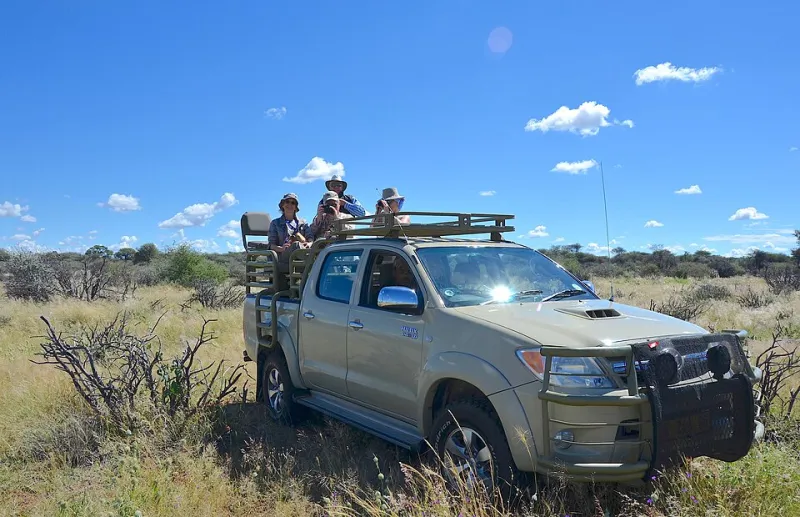
No Wi-Fi. No agenda beyond the morning game drive. Time measured by sunrise and the sound of a hippo in the distance. The contrast isn't subtle — it's seismic.
The Attention Reset You Didn't Know You Needed
One of the most well-documented effects of nature immersion comes from something called Attention Restoration Theory, developed by environmental psychologists Rachel and Stephen Kaplan back in the 1980s. The basic idea: modern life demands what they call directed attention — the focused, effortful kind of concentration you use to answer emails or sit through a meeting. That type of attention fatigues.
Nature, by contrast, engages what they call involuntary attention — the effortless, curiosity-driven kind that kicks in when a leopard steps out of the brush or a herd of elephants crosses the road twenty feet in front of your vehicle. You're not trying to pay attention. You just are.
That shift gives your prefrontal cortex — the part of your brain responsible for decision-making, focus, and emotional regulation — a genuine rest. Studies have shown measurable improvements in cognitive performance after as little as a few days in natural environments. Ten days in the bush? That's a full system reboot.
What Happens When the Cortisol Finally Drops
Stress hormones are sneaky. Cortisol, the body's primary stress chemical, is useful in short bursts — it's what helped your ancestors react fast when something dangerous showed up. But chronic elevation rewires your brain in ways that aren't great: it shrinks the hippocampus (your memory center), disrupts sleep, and keeps your amygdala — the brain's alarm system — firing on a hair trigger.
Here's the irony of safari: yes, you're surrounded by genuinely dangerous animals. But the kind of alertness that comes from scanning the horizon for a pride of lions is fundamentally different from the stress of checking your inbox. One is acute, embodied, and resolves quickly. The other is ambient, unresolvable, and just keeps going.
Researchers studying cortisol levels in nature-immersion programs have found significant drops within 48 to 72 hours of leaving urban environments — and those drops are accompanied by improvements in mood, sleep quality, and immune function. Your body, it turns out, knows the difference between a lion and a deadline. One of them it was actually built to handle.
Memory Consolidation and the 'Vivid Recall' Effect
Ask anyone who's been on safari about a specific moment — the exact second a cheetah locked eyes with them, or the morning a family of wild dogs played around the vehicle — and watch what happens. The memory doesn't just surface. It arrives in full color, with sound and smell and the feeling of the air attached to it.
That's not sentimentality. That's neuroscience.
The hippocampus encodes memories more deeply when they're associated with strong emotional responses and novel sensory input. Safari delivers both in abundance. Every game drive is genuinely new — you have no idea what you're about to see. That novelty keeps your brain in a heightened state of encoding, which is why safari memories tend to be unusually vivid and durable compared to, say, a week in a beach resort you've visited before.
There's also the role of awe. Psychologist Dacher Keltner at UC Berkeley has spent years studying the cognitive effects of awe — that specific feeling of encountering something vast and beyond your ordinary frame of reference. His research suggests that awe reliably shifts people away from self-focused thinking, expands their sense of time, and increases prosocial behavior. Watching 10,000 wildebeest thunder across a plain? That qualifies.
The Dopamine Loop You're Actually Missing
We talk a lot about dopamine in the context of social media and its engineered reward cycles. But dopamine also plays a central role in curiosity, exploration, and the drive to seek out new experiences — its original evolutionary purpose.
Safari is, at its core, a sustained exploration experience. Every morning is a search. Every set of tracks in the dirt is a puzzle. The uncertainty of what you might see — and the occasional, extraordinary payoff — is a natural dopamine cycle that your brain responds to with genuine enthusiasm. It's the kind of engagement that tech companies spend billions trying to replicate artificially, and it's available in its original form in the Okavango Delta.
Several safari veterans describe coming home with a renewed appetite for curiosity in everyday life — noticing things they'd stopped seeing, engaging more patiently with problems, feeling less compelled to fill every quiet moment with their phone. That's not coincidence. That's a dopamine system that got recalibrated.
So How Long Does It Last?
This is the question everyone wants answered, and the honest response is: it depends. Research on nature-based interventions suggests that the cognitive and emotional benefits can persist for weeks to months after the experience. The more deeply immersive the trip — and safari, by design, is about as immersive as travel gets — the longer the effects tend to hold.
What safari veterans consistently report is that the shift isn't just emotional. It's perceptual. They notice more. They react less. They feel, in some hard-to-articulate way, more like themselves.
Neuroscience is still catching up to what those travelers already know. But the picture that's emerging is clear enough: the bush doesn't just give you great photos and a story to tell at dinner. It gives your brain a genuine chance to remember what it was built for.
And that, it turns out, is worth every hour of the flight.